1. What Is Xing Ming Shuang Xiu?
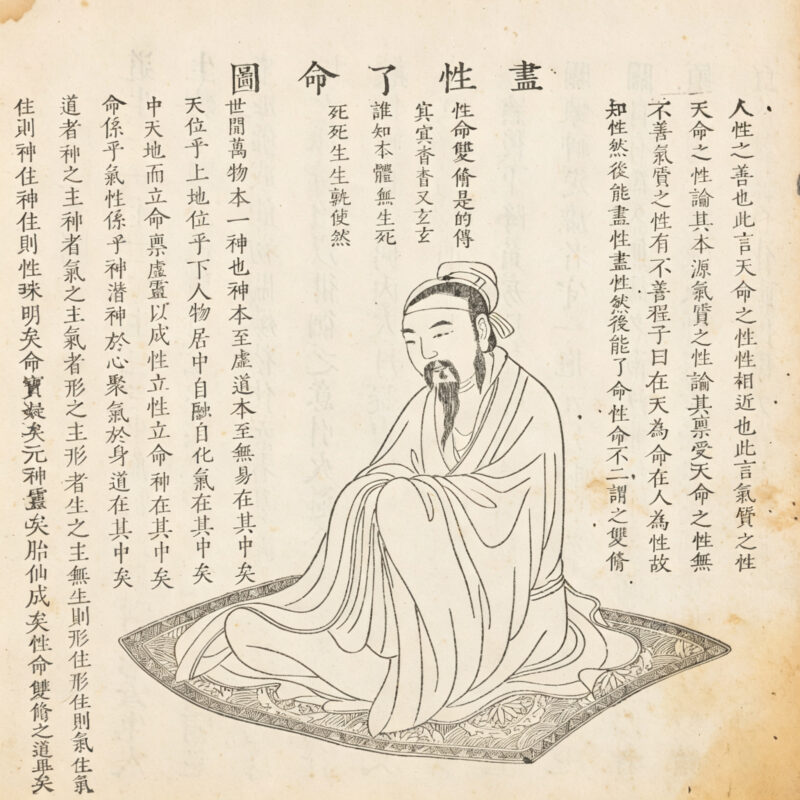
Xing Ming Shuang Xiu (性命双修) — the dual cultivation of inner nature and life — is a core concept in Daoism. It refers to the complete and simultaneous cultivation of both body and mind, aiming toward the highest state of human wholeness. It is not only a guiding principle of Daoist philosophy, but also a practical method of inner training. More precisely, it is a key term in Neidan (内丹, Internal Alchemy) . Extending the idea further, it is also one of the foundational philosophies behind traditional physical cultivation in ancient China — perhaps the most refined expression of classical health and wellness thought.
To understand dual cultivation, we must first understand the two terms:
Xing (性) — Inner Nature
Xing refers to the original nature of the human heart-mind — our “true face” before conditioning. In Daoist texts, it is also called Yuan Xing (元性, Original Nature), Zhen Xing (真性, True Nature), Yuan Shen (元神, Original Spirit), Zhen Xin (真心, True Heart), Tian Xin (天心, Heavenly Mind), Dao Xin (道心, Dao-Mind), and “a single point of numinous light.” In modern language, it points toward mind, spirit, consciousness, and character.
Why can it be called “Heavenly Mind” or “Dao-Mind”? Because, speaking broadly, just as humans have a human heart, the Dao itself has a Dao-heart. When cultivation reaches maturity, the human heart can merge with the Heavenly Mind. Heaven and human become one heart.
Ming (命) — Life
Ming refers to the human life-body — formed from the union of Heaven and Earth’s Qi and rooted in what one receives from before birth. More accurately, it points to the Yuan Qi (元气, Original Energy) within that living body.
Zhang Sanfeng wrote in the Da Dao Lun (大道论) : “When spirit and thought settle into stillness, Yuan Qi grows steadily from within — this is called true Ming.”
In contemporary terms, Ming points toward life, body, energy, material substance, vitality, and even destiny. As long as we follow the rhythms of Yin and Yang and harmonize with the laws of nature, Ming, too, can unite with the Dao.
The modern Daoist figure Chen Yingning (陈撄宁) put it simply: “Xing is our numinous awareness; Ming is our living vitality.”
Simply put: Xing Ming Shuang Xiu means cultivating spirit and body together — a complete practice of mind and body as one.
2. Why Practice Dual Cultivation?

If Ming refers to our physical life, and Xing to our inner nature, then human existence is nothing other than the unity of these two. Both are indispensable.
A human life is woven from both spiritual and physical threads. When people speak of “health,” they emphasize both body and mind. In just two characters, Xing and Ming summarize the two great pillars of human existence.
In the Daoist view, a true human being is not only a life expressed through form and Qi (形气) , but also a nature expressed through a true heart (真心) . A person is a living unity of life and true nature. Further still, a person is not just form, Qi, and spirit added together — but an organic unity of all three.
From the perspective of practice, dual cultivation can be divided into:
- Xing Gong (性功) — inner nature work
- Ming Gong (命功) — life-force work
Cultivating the inner nature is not exclusive to Daoism — Confucian traditions also engage in it. Though their values and methods differ, there is common ground. Ming Gong, however, is traditionally considered Daoism’s unique domain. Without it, one can hardly speak of Daoism. At its heart, Daoism values life, delights in living, and pursues longevity — a life-centered philosophy that distinguishes Daoist cultivation.
But these two must not be separated. As the Zhong He Ji (中合集) states:
“Xing without Ming cannot stand; Ming without Xing cannot endure.”
The Xuan Fu Lun (玄肤论) also says:
“Without Ming, Xing cannot manifest. Without Xing, Ming has no spirit.”
Xing and Ming are united in one body — two functions of one essence.
Chen Yingning used a beautiful metaphor:
Xing and Ming depend on each other; Ming is the foundation.
They are like an oil lamp: the oil is Ming, the flame is Xing. With a lamp but no oil, the light cannot shine. The purpose of Daoist cultivation is to help people gather enough oil — and to teach the art of lighting the lamp — so that life shines with enduring radiance.
3. The Modern Relevance of Dual Cultivation
While the concept of Xing Ming Shuang Xiu is essential for inner cultivators, the broader philosophy — cultivating both body and mind — applies to everyone.
In fact, it is especially meaningful today. In our increasingly competitive world, many people suffer in both Xing and Ming.
“My heart is so tired.”
How many have felt this? Chronic stress, anxiety, and depression are widespread. This mental-emotional burden often leads to physical illness — what we now call psychosomatic conditions.
In Chinese medicine, Liver Qi stagnation (肝气郁结) can invade the spleen and stomach, causing bloating, poor appetite, nausea, acid reflux, and digestive weakness. The mind affects the body directly.
Conversely, when the body is exhausted, the spirit weakens. Chronic Fatigue Syndrome is a modern example — body and mind both drained.
True health rests equally on both pillars. Physical strength must be paired with emotional resilience and a sound mind. As the Xing Ming Gui Zhi (性命圭旨) states:
“Shen does not leave Qi; Qi does not leave Shen.”
“Xing does not leave Ming; Ming does not leave Xing.”
When both the spiritual life and the physical life flourish — that is a truly happy life.
Since the body can transform the mind, and the mind can transform the body:
- Those who are physically weak may begin with Ming Gong: medical treatment, gentle physical practices, or deeper work — refining Jing into Qi (炼精化气) — to restore health, and through health, bring the mind to stillness.
- Those who are emotionally fragile or chronically negative should begin with Xing Gong: adjusting psychological balance, reducing excessive desires, opening the heart. As the ancient text says: “Keep the will at ease and let desires be few (志闲而少欲).” Then combine this with Qi practice — letting Shen guide Qi, and Qi guide form — to bring change from the inside outward.
Xing cultivation can be simple and accessible:
- Read the classics: the Dao De Jing (道德经) , the Qing Jing Jing (清静经) .
- Sit in quiet meditation.
- Learn from those with genuine wisdom and life experience.
- Practice self-reflection: What desires drive me? What am I chasing? Are these balanced?
- Cultivate kindness and connection: engage in meaningful social life, learn to care for others, grow in empathy.
All of this is already inner cultivation. From here, if interest deepens, more formal practices — Xin Zhai (心斋, fasting of the heart-mind), Cun Xiang (存想, visualization), Cun Shen (存神, spirit-focusing), Zuo Wang (坐忘, sitting in forgetfulness) — can be taken up under the guidance of a qualified teacher.
4. Two Paths in Dual Cultivation
Since the Song and Yuan dynasties, two main approaches to dual cultivation have emerged within internal alchemy:
The Southern School (Nan Zong 南宗): Ming First, Then Xing
This path begins with refining Jing into Qi (炼精化气) and progresses gradually:
- Build the foundation (筑基) : reaching the state where Jing is full, Qi is sufficient, and Shen is flourishing — the threefold fullness (三全).
- Refine Jing into Qi — the Small Heavenly Circuit (小周天). Refine Qi into Shen — the Great Heavenly Circuit (大周天).
- Refine Shen and return to Emptiness (炼神还虚) — pure Xing work, where original nature shines clear and luminous.
This is the gradual path. With correct and steady practice, perseverance brings success.
The Northern School (Bei Zong 北宗): Xing First, Then Ming
Founded by Wang Chongyang (王重阳) , who swept away what he saw as deviations, restoring the pure cultivation spirit of the Dao De Jing. His Complete Perfection School (Quan Zhen 全真) emphasizes clarity and stillness, awakening true nature before working on life energy. Zhang Sanfeng (张三丰) later inherited this tradition.
This path is closer to sudden awakening. For those with the right capacity and root nature, insight into original nature dawns first. From that clarity, Ming cultivation unfolds naturally.
The Common Ground
Despite different sequences, all schools agree:
Xing and Ming are one. Spirit and form depend on each other.
Dual cultivation is essential — neither side can be neglected.
The guiding principle is universal:
Xing is the guide; Ming is the foundation.
The method:
Stillness nourishes Shen. Movement nourishes form.
Only when form and spirit are both complete can one live out one’s full years in health.
Wang Chongyang himself said: “The original source of Xing and Ming has neither gain nor loss — vast and immeasurable, beyond words — this is the Dao.”
The Qiao Yao Ge (敲爻歌) , attributed to Lü Dongbin (吕洞宾) , warns:
“To cultivate only Xing and not Ming — this is the first sickness of practice.”
“To reach Ming but forget the ancestral Xing — like a traveler holding a mirror with no light.”
And Zhang Boduan (张伯端) , after weighing all paths, concluded that nothing surpasses the integrated dual cultivation of internal alchemy — neither Xing nor Ming neglected, Dao and Chan interwoven. This, he held, is the highest vehicle.
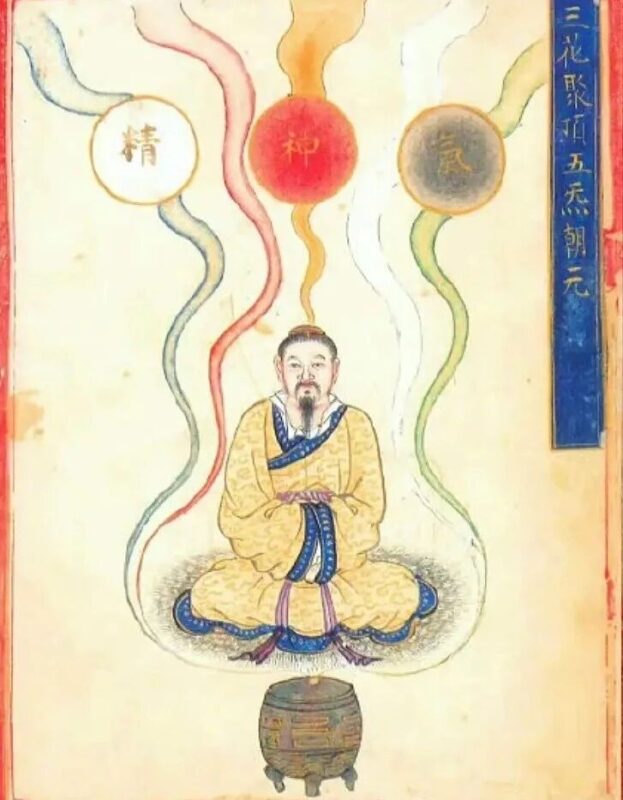
The ultimate purpose: to activate the gathering and transforming of Jing (精, Essence), Qi (气, Vital Energy), and Shen (神, Spirit) within — achieving lasting stability of form and spirit, and wholeness of body and mind.
5. Living the Wisdom
Even today, we can draw life-wisdom from this ancient practice — in how we live, work, care for our health, and cultivate our inner being. Done well, form and spirit remain united. We live out our natural span in peace, health, and wholeness.
Bring Xing Ming Shuang Xiu Into Your Daily Life
Understanding the philosophy is the first step — but true transformation comes from practice. Whether you want to begin with understanding your innate constitution, or dive directly into body-mind cultivation, we offer two supporting paths:
- Discover Your Inner Blueprint (命理): A personalized Chinese metaphysics consultation can help you understand your natural tendencies, strengths, and areas of imbalance — giving clarity to your Xing (inner nature) and how to best support your Ming (life-force).
- Cultivate Qi and Strengthen the Body (练气): Our Daoist Qigong courses — including Zhan Zhuang (standing meditation), Baduanjin (Eight Brocades), Wuqinxi (Five Animal Frolics), and Tai Chi — guide you step by step through the physical cultivation side of dual practice.
👉 [Explore Destiny & Qi Cultivation]
Stillness nourishes the spirit; movement nurtures the life force. Both are here for you.
If you’re interested in exploring Daoist philosophy beyond practice, the Stanford Encyclopedia of Philosophy offers an excellent scholarly overview of these ideas. Read more here: Stanford Encyclopedia of Philosophy — “Daoist Philosophy”