In modern society, many hold complex feelings toward the word “destiny.” Some firmly believe fate is fixed, that everything in life is predetermined and unchangeable. Others remain skeptical, seeing destiny as little more than an excuse or comfort for failure. On one hand, we hope to shape the future through effort; on the other, life’s unknown difficulties can make fate feel like an irresistible, mysterious force.
What is the Taoist view of destiny? For Taoism, destiny is neither fixed nor denied. It is both part of the Tao and part of one’s inner cultivation.
Destiny Through a Taoist Lens
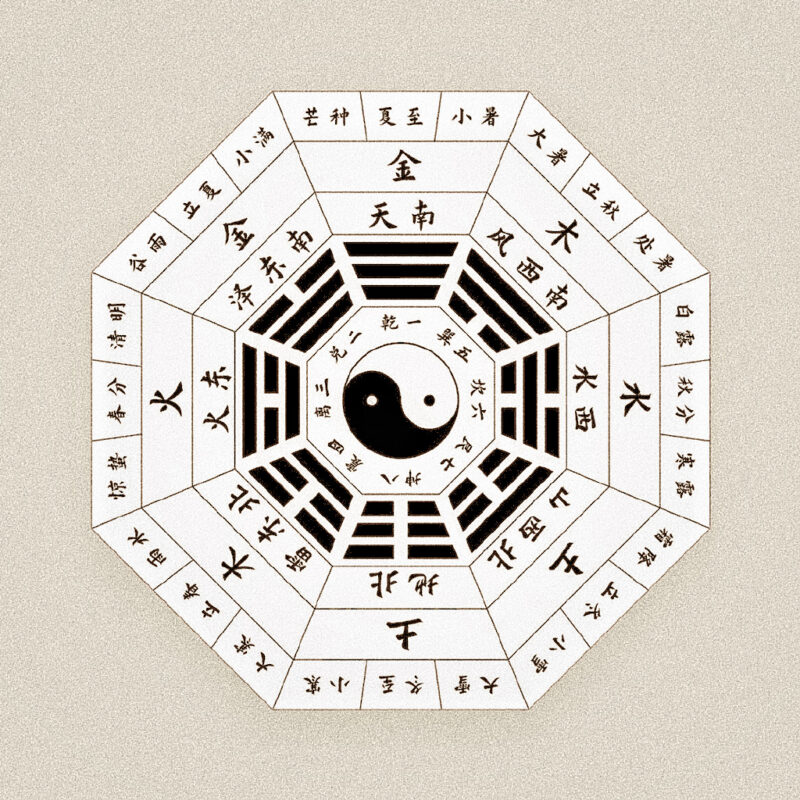
In Taoist thought, destiny is not a mechanical, rigid outcome. It is woven into the cosmology of yin and yang, the Five Elements, and the rhythms of Heaven and Earth.
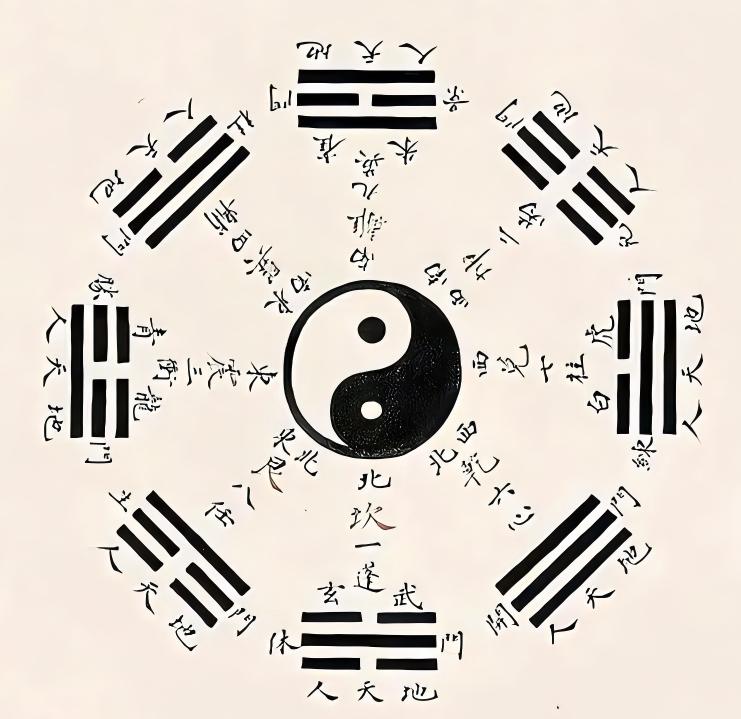
From the first cry of a newborn, life receives the qi of Heaven and Earth — the energies of yin and yang and the Five Elements that permeate all existence. The Eight Characters (Bazi) of one’s birth — the year, month, day, and hour expressed through the Heavenly Stems and Earthly Branches — are, in essence, time itself encoded as yin-yang and Five Element energies. Taoist Mingli (destiny principles) holds that the contours of a person’s life — fortune, hardship, clarity, struggle — can be read from this energetic blueprint. A birth chart is not unlike a prescription written by Heaven and Earth, a reflection of the forces present at one’s first breath.

Beyond the Eight Characters, Taoism developed a more refined system known as Zi Wei Dou Shu (Purple Star Astrology). Where Bazi maps the broad architecture of a life, Zi Wei Dou Shu — charting the positions of symbolic stars at the moment of birth — reveals finer layers: innate character, the rhythm of each life phase, and the interplay of strengths and challenges across time. Together, these systems form the heart of Taoist Mingli: not fortune-telling, but a way to read the landscape of one’s life with clearer eyes. Every chart holds a quiet pattern — the energetic currents that shape a life. It is not about prediction, but about seeing more clearly the path already beneath your feet.
Ming and Yun: The Two Faces of Destiny
In Taoist Mingli, destiny is divided into two parts: Ming (命) and Yun (运).
Ming is innate — the conditions given at birth: time, place, family, constitution. It is the part we do not choose.
Yun is acquired — the environments, encounters, and opportunities that unfold across different stages of life. It carries far more fluidity.
A birth chart reveals how Heaven and Earth shaped a person’s starting point and what influences will arise along the way. But this is not the same as saying fate is sealed. The chart illuminates the currents — it does not demand a single route through them.
How Then Should We Understand Destiny?
An old saying goes: “If a person reaches forty and still does not believe in destiny, their clarity is lacking.” Confucius himself said: “Without knowing Ming, one cannot be a junzi (a person of virtue).”
If a person refuses to acknowledge destiny, they tend to attribute all of life’s outcomes — wealth or poverty, success or failure — to effort alone. Their entire pursuit narrows toward material gain, as if everything were within their control. But much of what shapes a life is not.
To spend a lifetime fixated on outcomes that lie beyond one’s power — Confucius considered this the mark of one who could never become a true junzi. Only when we understand that fortune and hardship belong to the domain of destiny can we turn our attention toward what truly matters: the meaning of life itself, whether in abundance or in simplicity.
The Place of Personal Choice

Some might ask: if destiny is already set in its broad outlines, is effort futile? That is fatalism — and Taoism does not go there.
The birth chart offers a framework, not a prison sentence. Within its contours, countless choices remain. It is like a chessboard: the board is given, but every piece is moved by one’s own hand.
Ge Hong, the renowned Taoist scholar and alchemist of the Eastern Jin dynasty, put it plainly in the Baopuzi Neipian: “My destiny lies with me, not with Heaven. Refine the inner elixir, and life stretches beyond measure.”
To know one’s destiny is not to lie down and surrender. It is to face life’s challenges with clearer perception, and to find the best way through. This view — that understanding destiny does not mean surrendering to it — runs through much of Taoist thought. For a broader philosophical context on Taoism and its view of self-determination, see the Stanford Encyclopedia of Philosophy entry on Daoism.
As the I Ching teaches: “Heaven moves with vigor — the junzi strengthens himself without ceasing.” And Confucius, again: “I do not blame Heaven, nor do I fault others. I study what is near and reach toward what is above. Those who know me — perhaps only Heaven.”
In the Taoist view, once a person understands their Mingli, the task is to harmonize Ming and Yun through cultivation, through wisdom, and through alignment with the natural way. The birth chart can reveal where challenges and support will arise — in relationships, in work, in family. To see the pattern is to be able to move with it rather than against it.
This is not merely interpretation. It is clarity. It is the quiet confidence to act when the way is open, and to hold steady when mist still obscures the path. To know one’s destiny is, in the end, not to be bound by it — but to walk through life with eyes open, and a heart that understands.