
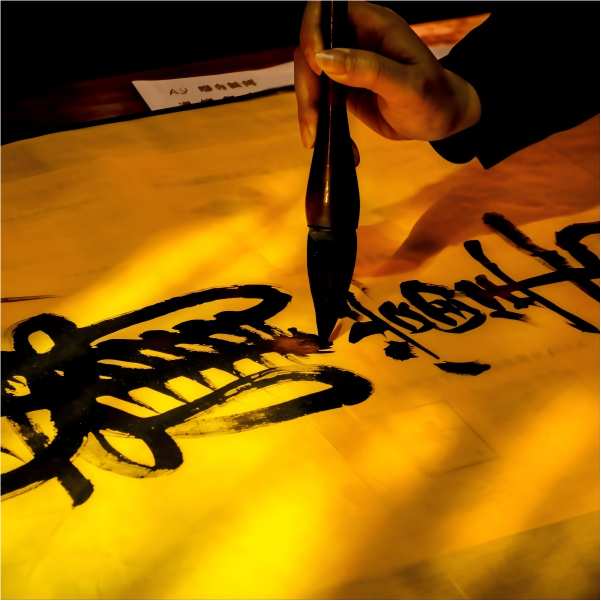
How to write a Taoist talisman is the foundation of all talisman practice. First you write it, then you prepare it, then you use it — this is the natural order. The process involves many details. Let us explain them layer by layer.
How to Write a Taoist Talisman: Materials
How to write a Taoist talisman begins with understanding the materials. These are similar to those used in ordinary calligraphy, but with sacred specifications.
Writing Tools
- Brush — the most commonly used
- Hand, sword, or ritual tablet — used for “void-writing” (虚书, Xu Shu — writing in empty space without leaving a trace)
- Ink and prepared cinnabar
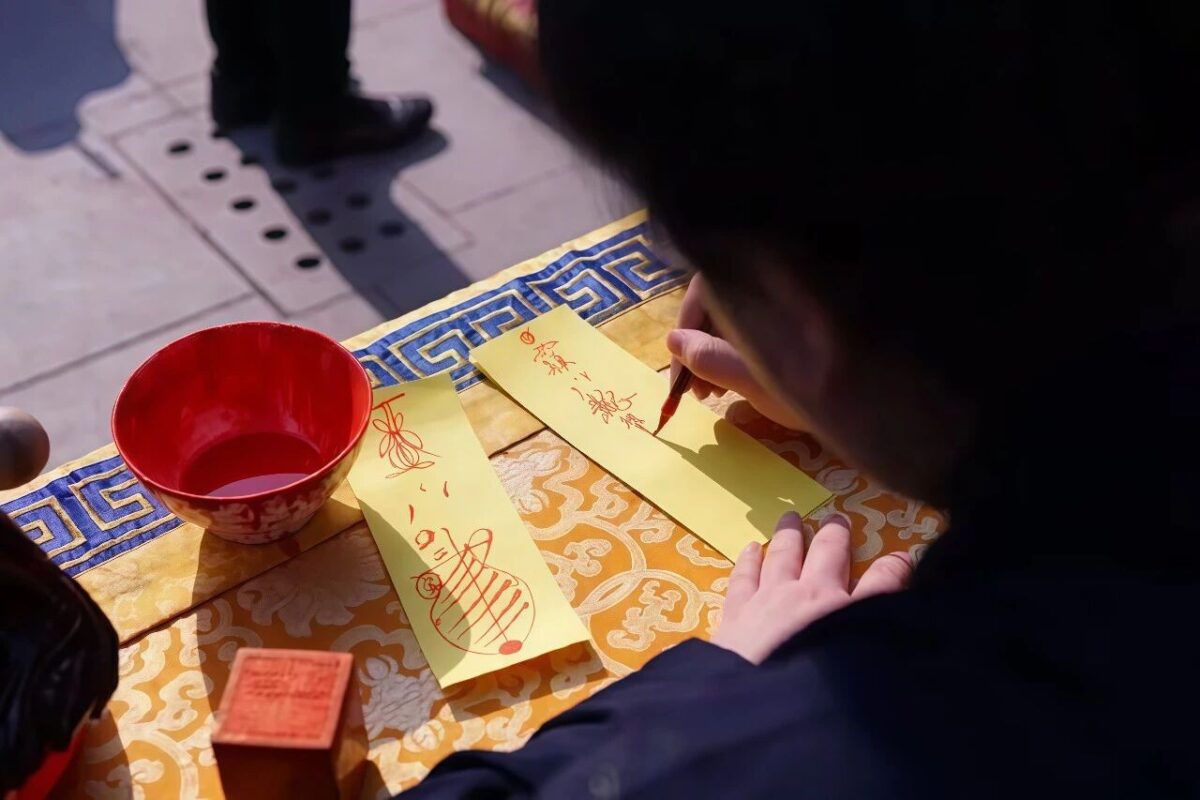
Surfaces for Writing
Talismans can be written on any surface, including empty space, water, fire, paper, silk, stone walls, wooden slips, iron tablets, and ritual implements.
Paper and silk are the most common. Stone walls, wooden slips, and iron tablets preserve talismans for long periods.
According to talisman theory, the essential function of a talisman is to contain Qi (寓炁, Yu Qi). Anything that can hold a talisman and contain its Qi can serve as a surface.
The Han Tianshi Shijia (汉天师世家) records:
“The nineteenth Celestial Master, named Xiu, styled Dezhen, was simple and honest. He farmed in the fields himself. When people came to him with illness, he would write talismans on leaves, and they would be cured.”
How to Write a Taoist Talisman: The Three Methods
How to write a Taoist talisman involves three main methods: writing (书), void-writing (虚书), and eye-tracing (目运).
Writing (书, Shu)
This is the general term for drawing talismans, and in specific methods, it refers to actually writing the talisman on a surface.
Void-Writing (虚书, Xu Shu)
This means writing talismans facing empty space, water, or fire — or facing a person or object without actually writing on them. No written trace is left.
Void-writing can be done with a brush, but more often uses fingers (forming the Sword Seal), a sword, or a ritual tablet.
With a sword, it is called “raising the sword to write talismans” (卓剑书符). This is commonly used when commanding spirit-generals.
Eye-Tracing (目运, Mu Yun)
Also called eye-writing (目书), this means using the flashing movement of the eyes to trace talisman forms in the air.
The Ming Dynasty Taoist Zhao Yizhen explained:
“The Spirit of a person rides on Qi. The mechanism lies in the eyes. Where the eyes go, Spirit and Qi are present. When the heart moves and the eyes focus, the Spirit emerges. When the heart rests and the gaze turns inward, the Spirit returns.”
In this process, the priest must first clearly visualize the talisman form in his mind, and coordinate the movement of inner Qi with the flashing of his gaze. The former depends on visualization (存想). The latter depends on Qi methods (炁法). Explore authentic Taoist talismans →
How to Write a Taoist Talisman: The Ritual Process
How to write a Taoist talisman involves not only correctly executing each stroke, but also applying one’s daily religious cultivation — using Qi circulation, visualization, mantras, and hand seals.
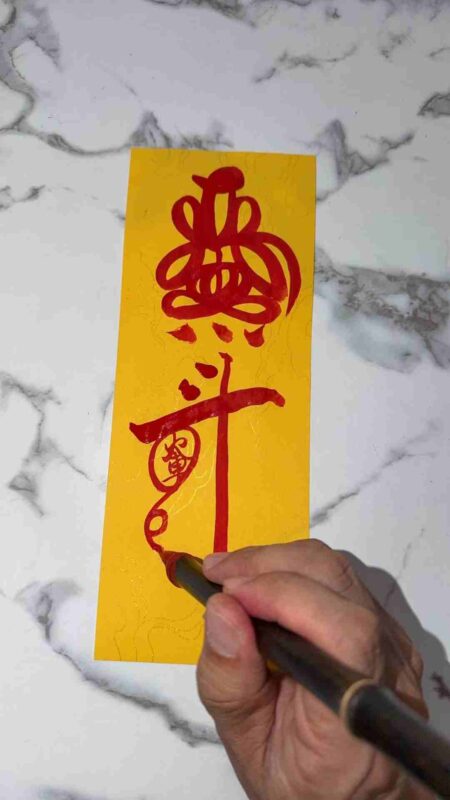
Here we cite the process of drawing the Zhang Messenger Talisman from the Xiantian Yiqi Huolei Zhang Shizhe Qidao Dafa (先天一炁火雷张使者祈祷大法).
According to this text:
“First, set up the desk, burn incense, and check that paper and brush are in order. Then, concentrate the Spirit and sit upright in stillness. Secretly circulate Essence, Qi, and Spirit to gather them into one. Take the brush in hand. Secretly recite the heart mantra. Concentrate for a long while. When the signal arrives, make the intention and put brush to paper. One dot on the paper — the Messenger’s prenatal Qi is already formed. Rouse the body and stand firm. With angry intent, sweep it into completion in one stroke.”
“Intention and brush turn together. Qi and brush move together, without interruption. In a hazy instant, heart and Spirit meet. The general follows the command.”
The specific method: first draw the scattered form (散形), then complete the gathered form (聚形). The scattered form consists of twenty-five strokes, each with a corresponding mantra.
- First stroke: In stillness, place one dot as a symbol of the Messenger’s prenatal Qi.
- Second stroke: Write the strange character that is the Messenger’s name, pronounced Jue (珏).
When drawing, one relies heavily on visualization. For rain prayers, visualize the inkstone as a Heavenly Pool. For clear-sky prayers, visualize a mass of true fire blazing upward.
The brush’s rising, falling, exiting, and entering also have rules. For clear sky, exit the brush upward. For rain, exit downward. For killing and subjugation, exit toward Gen (艮, the northeast). For delivering memorials, exit toward Xun (巽, the southeast).
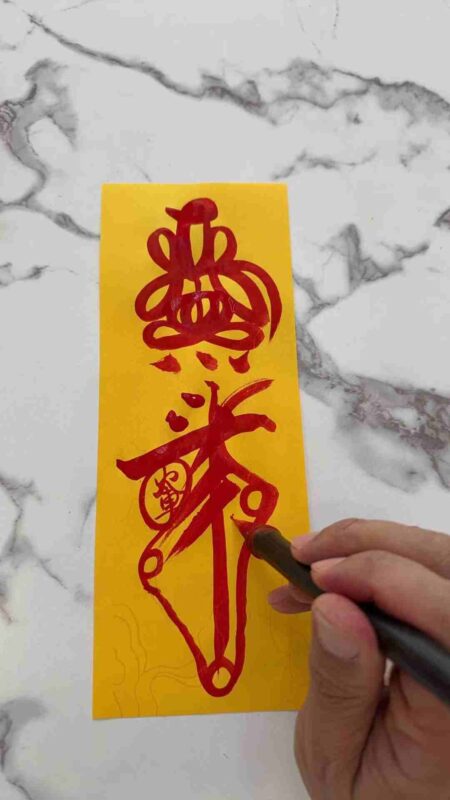
All these details finally form a gathered form (聚形). The same Messenger, due to different purposes, will have different talisman forms. Explore authentic Taoist talismans →
How to Write a Taoist Talisman: Consecration and Sealing
How to write a Taoist talisman also requires consecration. Take the Shangqing Tianpeng Fumo Dafa: Shufu Fashi (上清天蓬伏魔大法·书符法式) as an example:
“The master first recites the Purification of the Three Karmas Mantra. After silently petitioning the patriarchs, he lights a fierce fire and offers incense. He taps his teeth seven times. He visualizes the Big Dipper emerging from the Cavern Chamber and covering his body.”
“Then he recites the Tianpeng Mantra until ‘ten thousand ghosts self-destruct, quickly, quickly, as the law commands.’ He flicks the hand seal. He holds the tablet in the right hand and the Zi Wei seal in the left, facing the heart. He visualizes himself as the Marshal.”
“He grinds ink forty-nine turns to the left, reciting the Tianpeng Mantra. He turns right twelve times for the twelve hours, the twenty-eight constellations, the twelve monthly generals, and the seven stars’ names, taking Qi and blowing it into the inkstone.”
Tapping the teeth gathers the Spirit. The left hand forms the Zi Wei seal — because Tianpeng is subordinate to the Great Emperor of the Purple Star.
Then he recites the Inkstone Consecration Mantra, the Ink Consecration Mantra, and the Brush Consecration Mantra.
“For cinnabar, ink, or brush, take the Big Dipper’s Handle Qi and blow it into the brush. Breathe on the brush. Tap it three times. Recite the Jade Emperor’s name. Then put brush to paper to write the talisman. Assume an angry expression. The essential thing is to be as fast as wind and clouds.”
After the talisman is completed, the Zhengyi School often stamps it with the Celestial Master Seal (天师印) as a fixed form.
Explore authentic Taoist talismans →
Stanford Encyclopedia of Philosophy — Daoism