
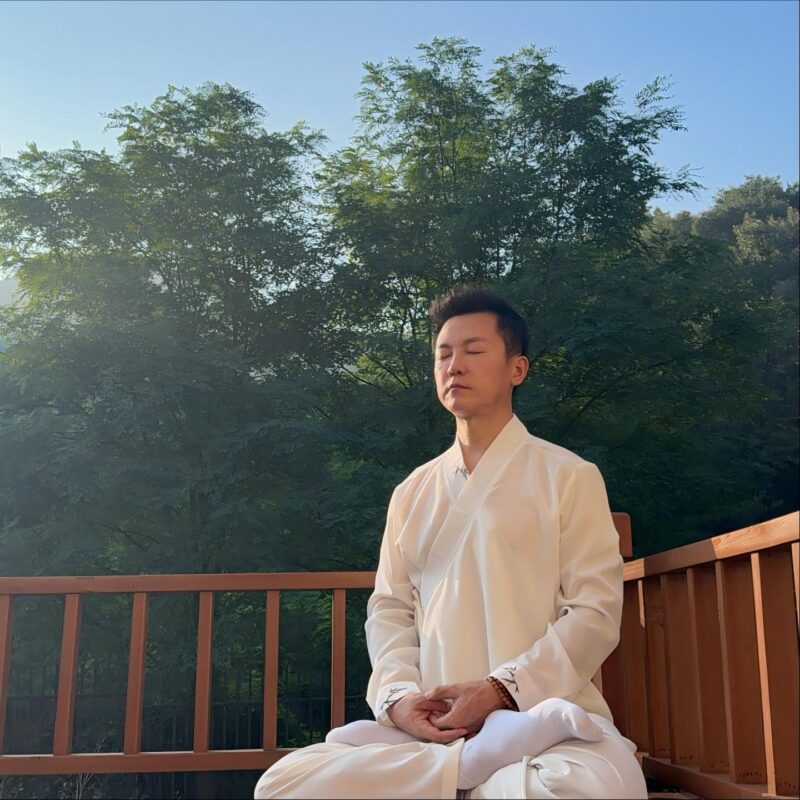
Taoist entering stillness is the first gate in the practice of internal cultivation — and also the most critical one. To enter stillness means to replace ten thousand wandering thoughts with a single thought, returning to a state of indistinct wholeness — hazy and formless, without separation, without distinction. Taoism calls this Guarding the One (守一). Buddhism calls it Entering Emptiness.
In the Tao Te Ching, Laozi describes this state:
“The Tao as a thing is vague and indistinct. Indistinct and vague, yet within it are forms. Vague and indistinct, yet within it is substance…”
After practicing Taoist entering stillness, the body’s functions undergo profoundly beneficial regulation, bringing Yin and Yang into balance and clearing the meridians. More importantly, it is only in the state of stillness that the Qi mechanism can be activated, and true Qi can arise and flourish.
The Lower Dantian is like a furnace. Only stillness can light its blazing fire. Like a steamer, only stillness can bring the water to a rolling boil.
But stillness is not only a skill to be cultivated over time — it also requires the practitioner to rise above worldly fame and gain, to follow goodness and honor virtue, and to seek inner peace with a quiet heart.
What Is the State of Taoist Entering Stillness?
What exactly is this “hazy and indistinct” state? The word “huanghu” (恍惚) is rich with meaning.
The scholar Nan Huai-Chin explained it this way:
“Huanghu refers to the realm of inner luminosity. We need not resort to complex textual analysis — simply look at the characters. ‘Huang’ (恍) is written with the heart radical beside the character for light. ‘Hu’ (惚) is written with the heart radical beside the character for suddenness. It means the heart-mind is luminous, floating freely, utterly alive — not at all confused or muddled.”
Two points deserve attention here.
First, the state of entering stillness is indeed one of “huanghu” — no separation, no distinction. It means letting go of everything, thinking nothing, requiring no logical reasoning whatsoever.
Second, within this hazy and indistinct state, the heart-mind is naturally luminous and naturally vibrant. This is what Laozi meant by “within it are forms; within it is substance.” This inner vision arises when practice reaches a certain depth, and the natural Qi of Heaven and Earth begins to work upon the practitioner’s internal Qi.
The Signs of Entering Stillness
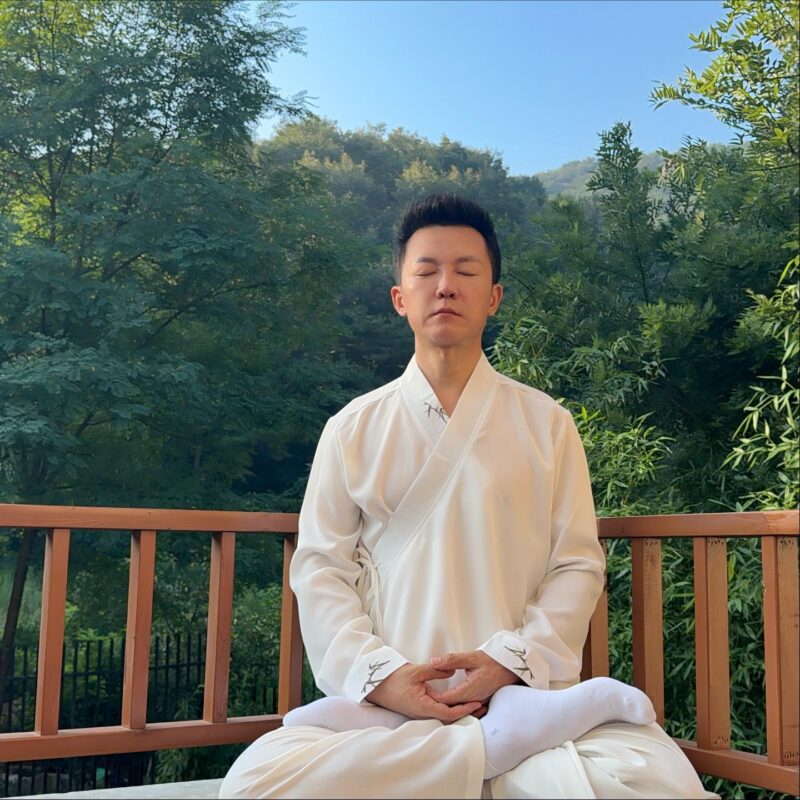
Every practitioner’s experience of Taoist entering stillness is different, depending on their constitution and depth of practice. Yet there are some common signs.
1. The Mind
You are in a state between sleep and wakefulness — but never in dull slumber. Ordinary thinking has stopped, yet a single thread of luminous awareness remains. In other words, the mind rests in pure sensation. You may still hear sounds — even the drop of a needle — but there is only awareness, no analysis. The mind is like a mirror-still lake. Not a ripple rises.
If you feel your very self dissolve, merging with Heaven — that is a deeper stage of stillness.
2. The Breath
You almost forget you are breathing. The breath becomes deeper, slower, more even, and finer than usual — like a single silk thread, neither loose nor taut, neither broken nor strained.
Sometimes ordinary breathing seems to stop entirely, giving rise to Embryonic Breathing (胎息) — the breath of the navel. Or the skin itself begins to breathe: coolness on the inhale, warmth on the exhale. Whatever arises, it is never the result of deliberate pursuit. Everything follows its natural course.
3. The Body
The most important bodily sign is the sensation of an energy field. You may feel a field of Qi surrounding the entire body, as true Qi merges seamlessly with the Qi of Heaven and Earth — indistinct, hazy, whole. This marks the threshold of stillness.
With continued practice, the body may feel infinitely expansive, until it seems to dissolve entirely. Some feel Qi rising like steam, the true Qi pulsing, rolling, and flowing in the Dantian, with warmth or light radiating through the body. Some feel light, as if floating skyward. Others feel heavy, as if sinking deep into the earth.
4. The Deeper Mind
At deeper levels of stillness, visions may appear at the point between the eyebrows — the Celestial Eye (天目). You may see deities, hear insects or birdsong, smell exquisite fragrances, or behold beautiful landscapes and pavilions in vivid detail.
These are called “demonic visions” . The practitioner must hold the mind steady — seeing without seeing, hearing without hearing, keeping the mirror of the heart free of ripples.
Four Classical Methods Of Taoist Entering Stillness
1. Taoist Entering Stillness: Through the Breath
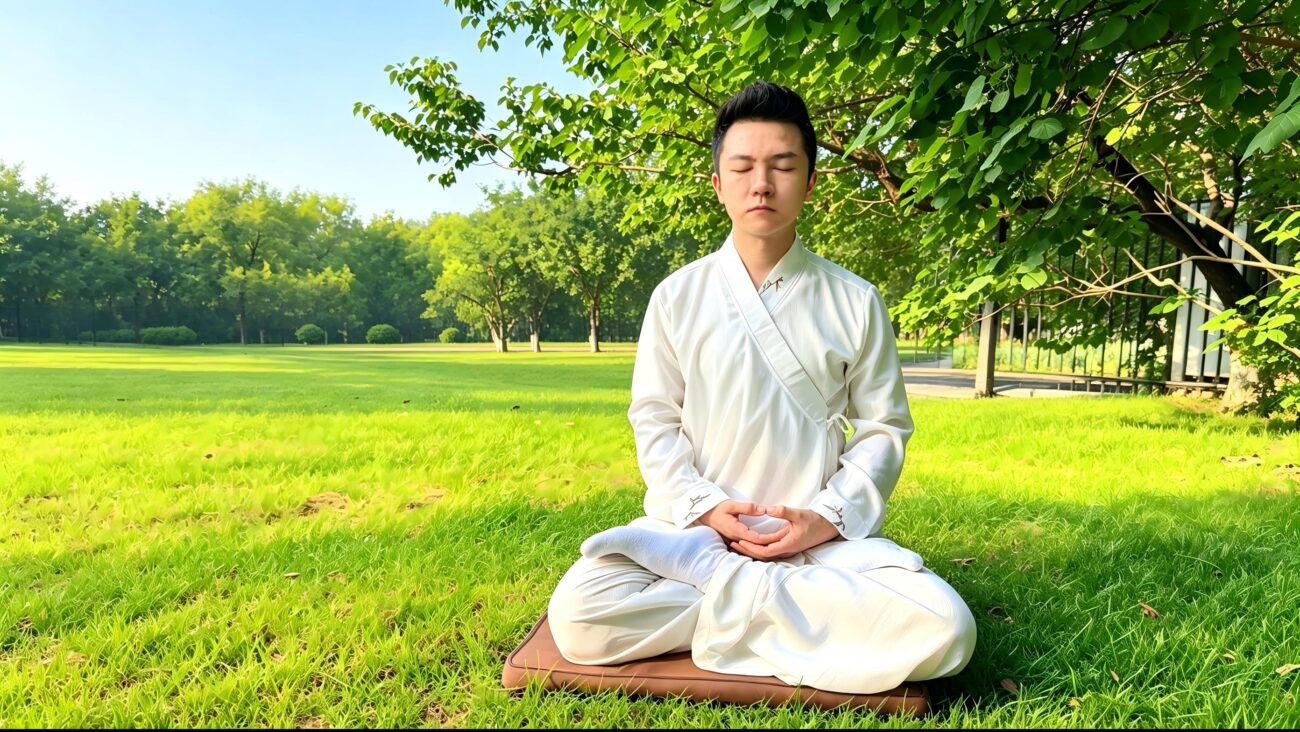
Also called Following the Breath, this method focuses the intention on the breath, following its rising and falling, its coming and going, to replace ten thousand thoughts with a single thought.
For beginners, this is a most accessible method.
You may focus only on the inhalation, letting the exhalation go naturally. Or focus only on the exhalation. Or follow both, moving with the breath as it rises and falls.
Once you have built a foundation and the meridians are largely open, you may shift awareness to the entire surface of the skin. Visualize the pores inhaling the pure, luminous Qi of the universe, and exhaling all illness and turbidity. Practice this for some time, then let go completely. Think nothing. Let the breath return to natural. Rest the mind in blankness, the body in soft comfort.
When scattered thoughts arise again, use the skin-breathing method to dissolve them. Thus, one thought replaces ten thousand, and step by step, you enter the deeper layers of stillness.
2. Taoist Entering Stillness: Through Intentional Guarding
This is the most commonly used method. The points most often guarded are the Upper, Middle, and Lower Dantian, the perineum (会阴), the Gate of Life (命门), and the Bubbling Spring (涌泉).
The advantage of this method is that Qi gathers quickly, and the sensation of Qi arrives soon. The drawback is that the “fire-phase” (火候) — the subtle intensity of attention — is not easy to master.
The general principle is: “Guard as if not guarding. Apply the lightest attention. Do not forget, do not force.” Some practitioners release their attention on the exhale; some release on the inhale.
Never lock the mind rigidly onto the point. Otherwise, Yang Qi may rise excessively, or Qi may stagnate, causing discomfort throughout the body — especially dizziness and head pressure.
Among the points, the Lower Dantian is most commonly guarded, for it is the sea where true Qi arises. Most practitioners of the Small Heavenly Circuit take guarding the Lower Dantian as their primary method. It is best combined with visualization.
3. Taoist Entering Stillness: Through Bodily Sensation
After practicing for some time, once the meridians have opened, various sensations will arise throughout the body. Buddhism speaks of the “Eight Touches” (八触): movement, itching, lightness, heaviness, coolness, warmth, roughness, and smoothness.
In truth, the inner sensations are far more than eight. Each person’s experience is unique.
The most important of these is the sensation of true Qi activating within the body — the feeling of Qi flowing, darting, pulsing. There is also the sensation of the whole body vibrating with Qi, like a gentle electric current, and the feeling of an energy field surrounding you. There is the warmth of Qi arising from the Dantian.
By carefully, minutely experiencing these sensations — by searching through the body for them — scattered thoughts are naturally set aside. This, too, is stillness.
Many practitioners find this method especially effective. It is gentle, causes no strain or side effects, and sharpens the power of inner awareness, laying the foundation for deeper practices.
4. Taoist Entering Stillness: Through Sacred Phrases
Each lineage has its own sacred phrases. Silently reciting them is a wonderful aid to stillness.
Language carries the power of suggestion. Phrases passed down through generations hold special resonance and remarkable power.
Here is a simple phrase you may use:
“Song — Jing — Tong — Dong”
(松 — 静 — 通 — 洞)
Relax — Still — Flow — Open
Recite it softly, letting the sound be long and gentle, rising and falling.
- On “Song” (Relax), feel the vibration travel from the perineum up to the crown.
- On “Jing” (Still), from the crown back down to the perineum.
- On “Tong” (Flow), from the perineum again to the crown.
- On “Dong” (Open), from the crown down to the soles of the feet.
- Then begin again with “Song,” from the soles back to the crown.
Repeat this cycle. With practice, you can stop making sound and simply recite the words silently. Even then, they will help you enter stillness and open the meridians.
The True Path of the Practitioner
Taoist entering stillness is not only a skill to be refined through practice. It also requires the practitioner to rise above worldly fame and gain, to walk in goodness and honor virtue, and to seek a peaceful heart.
Fundamentally, a luminous heart, open and untroubled, following goodness and cherishing virtue — this is the true path that every cultivator should walk.
Ready to go deeper?

The above is only the first gate of Taoist entering stillness. If you wish to take the next step — to learn how to activate true Qi, open the Ren and Du Meridians, and build the Inner Elixir step by step — our Taoist Neidan and Qi Cultivation Courses are here for you.

Featuring authentic Northern-school internal alchemy methods, including sitting meditation, Reverse Abdominal Breathing, and the complete pathway of the Small Heavenly Circuit.

[Explore the Full Course →]
For a deeper philosophical background on Taoist meditation and stillness, see the Stanford Encyclopedia of Philosophy’s entry on Taoism.