
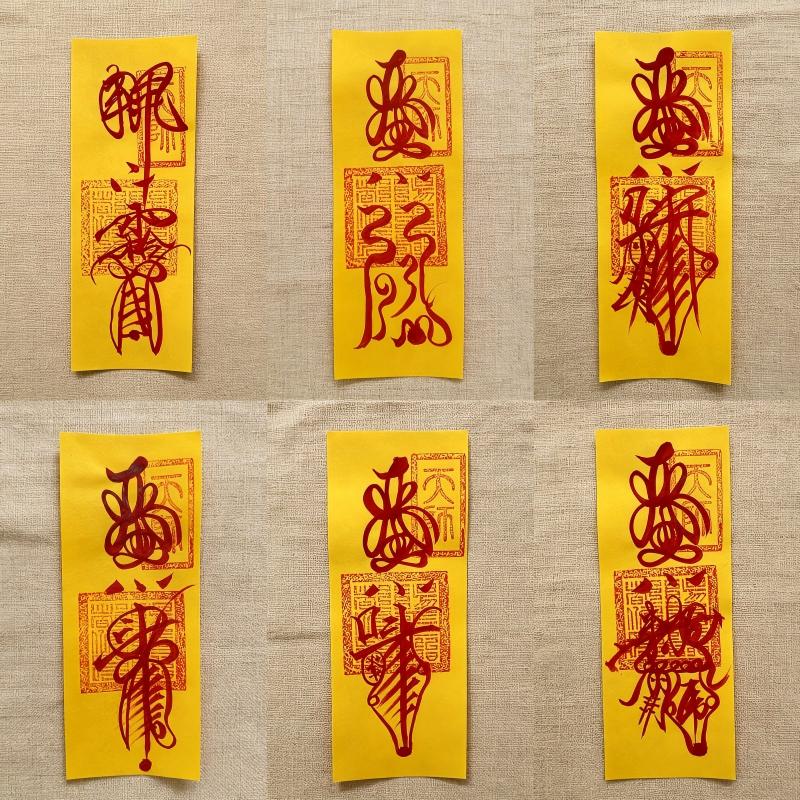
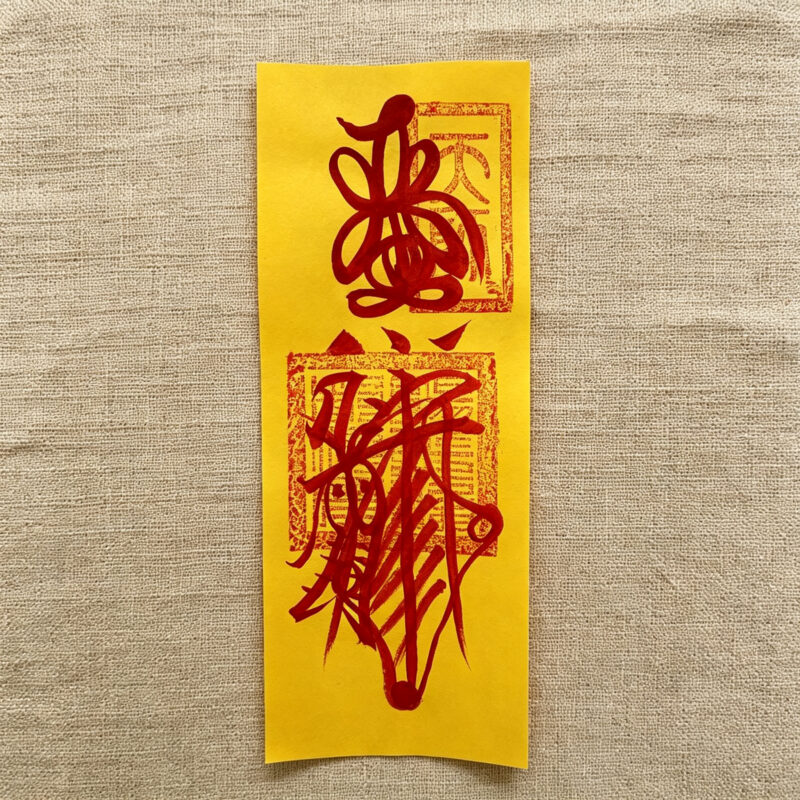
Taoist talismans are among the most iconic and sacred instruments in Taoist culture. They are not merely symbols or drawings — they are believed to be condensations of Primordial Qi, serving as spiritual contracts between humanity and the cosmos.
For over two thousand years, Taoist talismans have been used in Taoist rituals, internal alchemy, healing, and folk traditions. They are both a medium for communicating with Heaven and Earth and a profound spiritual treasure of Chinese traditional culture.
What Are Taoist Talismans?
The Taoist classic Daofa Huiyuan (道法会元) states:
“A talisman is union, a talisman is trust. With my spirit, I unite with the spirit of the divine. With my Qi, I unite with the Qi of the divine. Spirit is formless; the talisman gives it form. When I move, it responds. When I feel, it becomes numinous.”
And again:
“A talisman is the perfect union of Yin and Yang. Only those with utmost sincerity can use it. Spirit attaches to spirit, and the divine responds to the divine. Thus, on a small piece of paper, one may summon spirits and gods, and they cannot refuse.”
This is the true essence of Taoist talismans — they are not ordinary drawings made with red ink and black strokes, but materialized expressions of cosmic truth, the sacred script of the Three Lights, and vessels of primordial spiritual information.
Taoism teaches that the universe was born from the Three Qi — the Mysterious (玄), the Original (元), and the Beginning (始). When Yuan Qi gathers, it becomes spirit; when it disperses, it returns to Qi. Taoist talismans are the visible manifestation of this primordial Qi flow.
The Origin of Taoist Talismans
The history of Taoist talismans reaches back to ancient Chinese nature worship, star worship, and shamanic rituals. Ancient people used peach wood as “immortal wood,” carving peach charms to ward off evil and invite blessings — the earliest precursor to talisman culture.
During the pre-Qin period, bronze inscriptions for blessing the soul, exorcism dances, and door-god worship all gradually merged and evolved into early talisman forms. In the Han Dynasty, the Five Directions and Five Emperors beliefs were absorbed into Taoist talismans, which began to carry the meaning of protecting the nation and stabilizing the realm.
By the Wei and Jin dynasties, Taoism was formally established, and Taoist talismans were incorporated into the orthodox Taoist system. The True Forms of the Five Sacred Mountains and Inner Script of the Three Sovereigns became core talisman classics.
From the Sui and Tang dynasties through the Song and Yuan, schools such as Zhengyi, Shangqing, Lingbao, Shenxiao, and Qingwei flourished, each developing its own complete talisman system. In the Ming and Qing dynasties, Taoist talismans spread widely among common people, with local traditions developing unique characteristics.
The Written System of Taoist Talismans
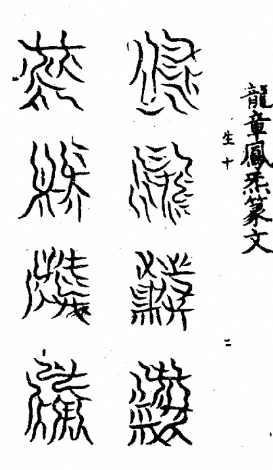
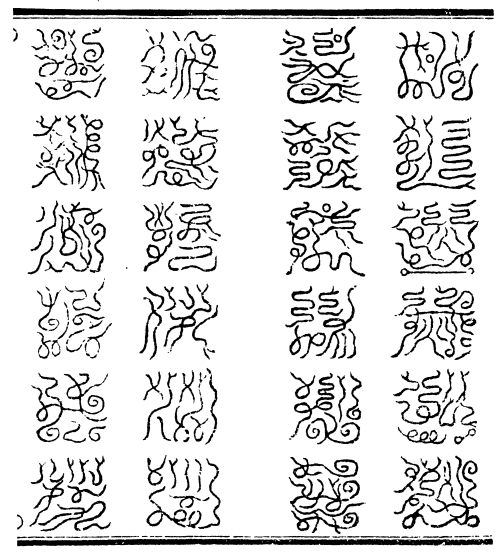
Taoist texts classify talisman writing into Eight Scripts (八体) and Six Writings (六文).
The Eight Scripts are:
- Heavenly Script (天书) — the original and highest source of talisman writing
- Divine Script (神书) — flowing cloud-seal characters used for communicating with the divine
- Earthly Script (地书) — dragon and phoenix forms for stabilizing land
- Inner Script (内书) — forms based on birds, insects, and animals
- Outer Script (外书) — ancient variants of traditional Chinese characters
- Ghost Script (鬼书) — thunder-writing for defeating evil spirits
- Xia Script (夏书) — standard characters widely used among common people
- Barbarian Script (戎夷书) — elements from ancient folk cultures
The Six Writings are:
- Cloud Seal (云篆) — characters flowing like clouds
- Eight Powers (八威) — powerful forms radiating light
- Dragon Script (龙章) — dragon-shaped writing
- Phoenix Script (凤文) — phoenix-shaped writing
- Jade Script (玉字) — the original sacred characters concealed in Primordial Qi
- Hidden Script (隐文) — characters visible only to the spiritually awakened
Three Categories of Taoist Talismans
Taoist talismans can be divided into three main categories:
- Heavenly Talismans — carrying the principles of Yin-Yang transformation and stellar phenomena, including talismans of the Big Dipper, the Southern Dipper, and the 28 constellations.
- Earthly Talismans — aligned with the energy of mountains and rivers, the most famous being the True Forms of the Five Sacred Mountains, used for protecting homes and stabilizing the land.
- Human Body Talismans — the most widely used category, focused on internal cultivation, healing, and protecting life. These are used in meditation, healing rituals, and personal protection.
Materials Used in Taoist Talismans
The materials used to create Taoist talismans are never random — they are chosen for their spiritual, medicinal, and symbolic properties:
- Cinnabar (朱砂) — a red mineral used for its calming, spirit-settling, and evil-dispelling properties. Its red color symbolizes solar Yang energy.
- Pine Soot Ink (松烟墨) — used for its cooling, blood-stopping, and organ-cleansing properties. Its black color corresponds to the Water element and the North.
- Peach Wood (桃木) — the original “immortal wood,” used for carving early charms and talisman boards.
Authentic Taoist talismans must be hand-drawn with these traditional materials. Mass-produced printed copies found online carry no spiritual efficacy because the materials, intention, and ritual process are all essential. If you’re looking for hand-drawn talismans made with traditional materials, explore our collection of authentic Taoist talismans.
The Ritual Process: How Taoist Talismans Are Made
Drawing a Taoist talisman is not a casual act. It follows a strict sequence of steps:
- Purifying the body and mind
- Invoking the masters and divine protectors
- Transforming the self to merge with the divine
- Preparing the instruments
- Receiving the divine order
- Writing the talisman
- Sealing and empowering it
- Activating the talisman’s spiritual opening
The entire process is accompanied by visualization, mantras, and ritual steps. As the Taoist saying goes: “The talisman has no fixed form; it is made efficacious by Qi.”
The Key to Effective Taoist Talismans: Inner Cultivation
The great master Sa Shoujian wrote:
“A single point of spiritual light — that is the true talisman. People waste their time with cinnabar and ink. The superior student holds this secret and practices diligently; flying into immortality is only a matter of effort.”
This “single point of spiritual light” is the Original Spirit (元神), the true source of Taoist talismans. Without inner cultivation and a pure heart, no talisman can be truly effective — regardless of how perfectly it is drawn.
The Practical Use of Taoist Talismans
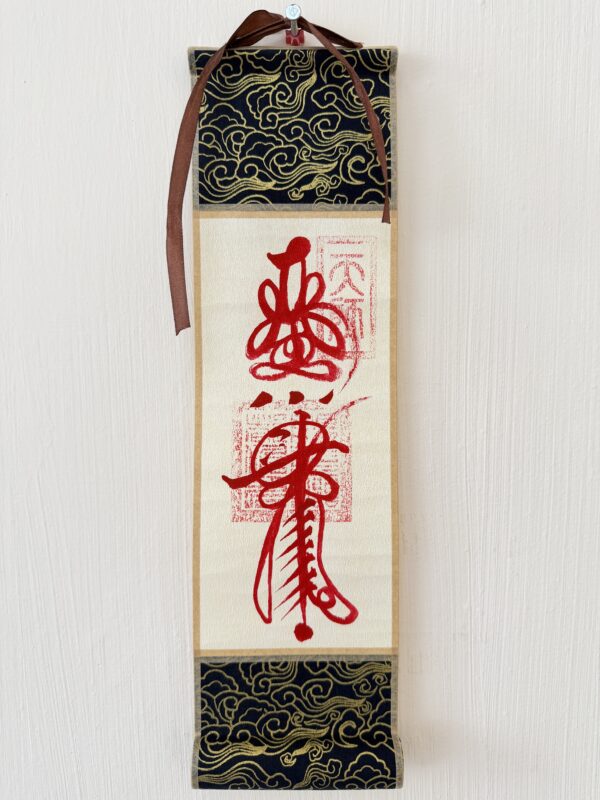
Taoist talismans are used for:
- Protection — personal, family, and home protection
- Healing — supporting recovery from illness
- Clearing negative energy — dispelling evil influences
- Blessings — attracting good fortune and prosperity
- Spiritual cultivation — supporting meditation and inner practice
They are often paired with mantras (咒语), forming the two pillars of Taoist ritual practice.
Preserving the Tradition
Today, orthodox Taoist talismans are preserved through lineages such as the Zhengyi (正一) school at Mount Longhu, the Shangqing (上清) school at Mount Maoshan, and the Qingwei (清微) thunder tradition.
These traditions maintain strict master-to-student transmission, ensuring that the talisman’s spiritual power remains genuine and unbroken.
Ready to bring this ancient tradition into your life?
👉 [Explore authentic Taoist talismans]
Stanford Encyclopedia of Philosophy — Daoism