
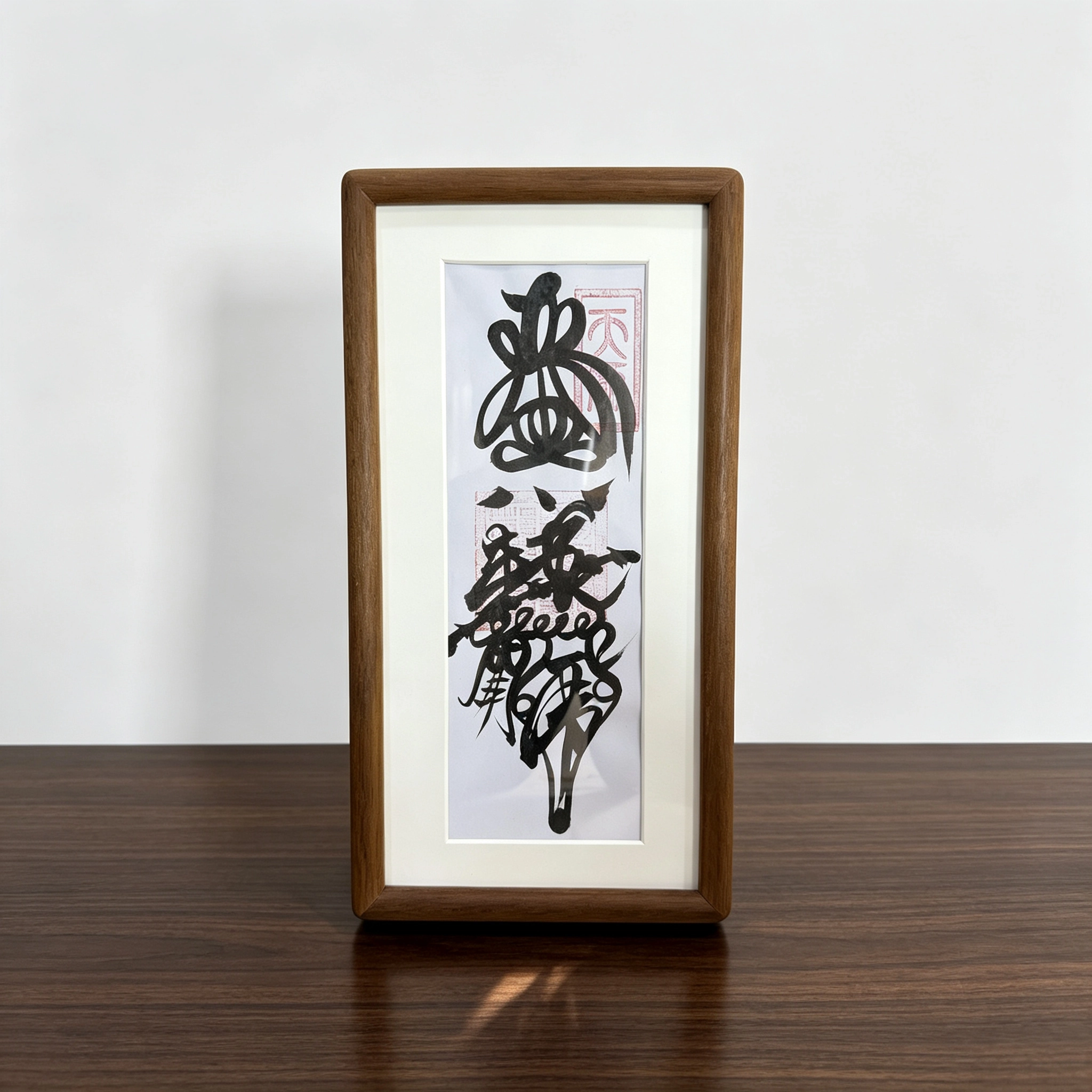
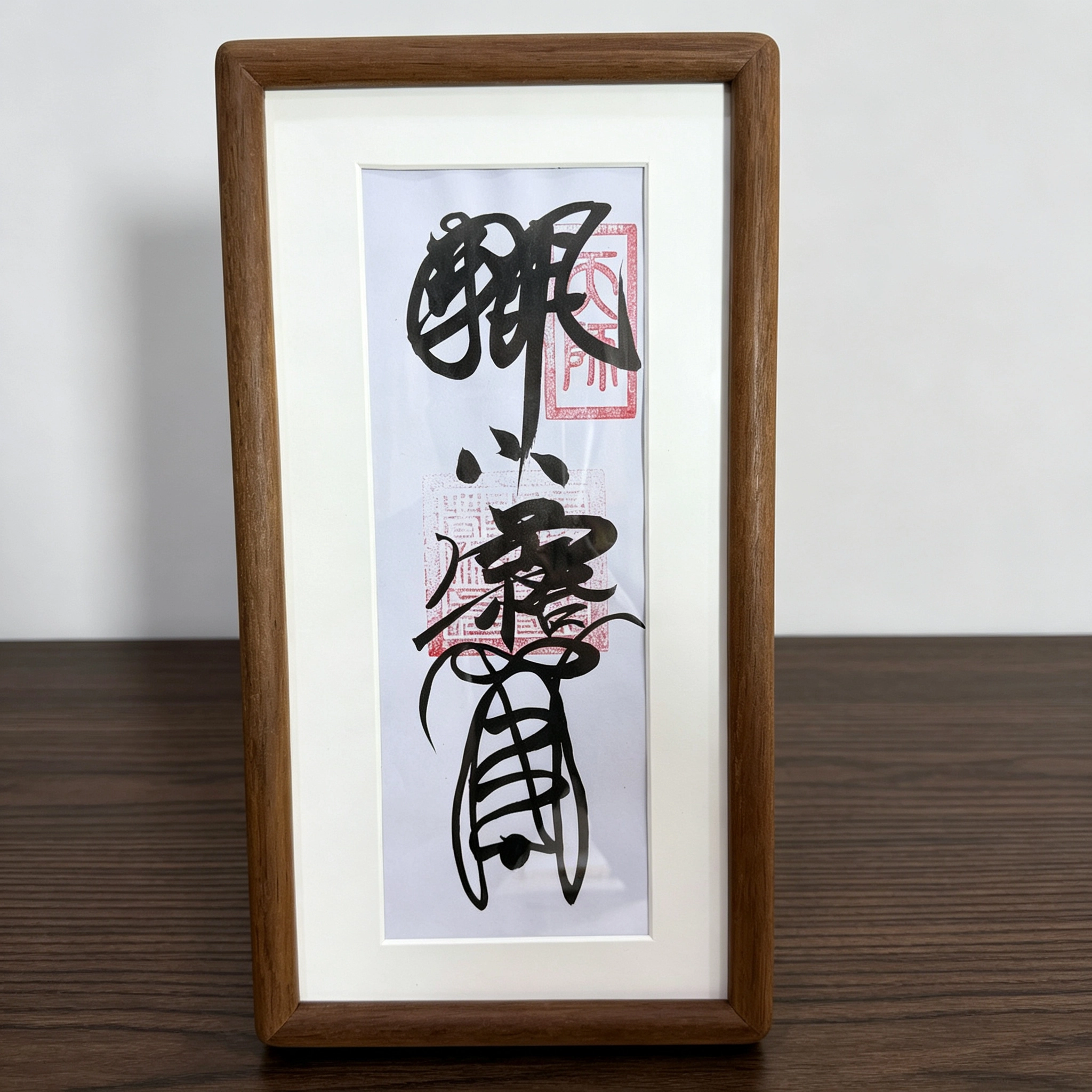
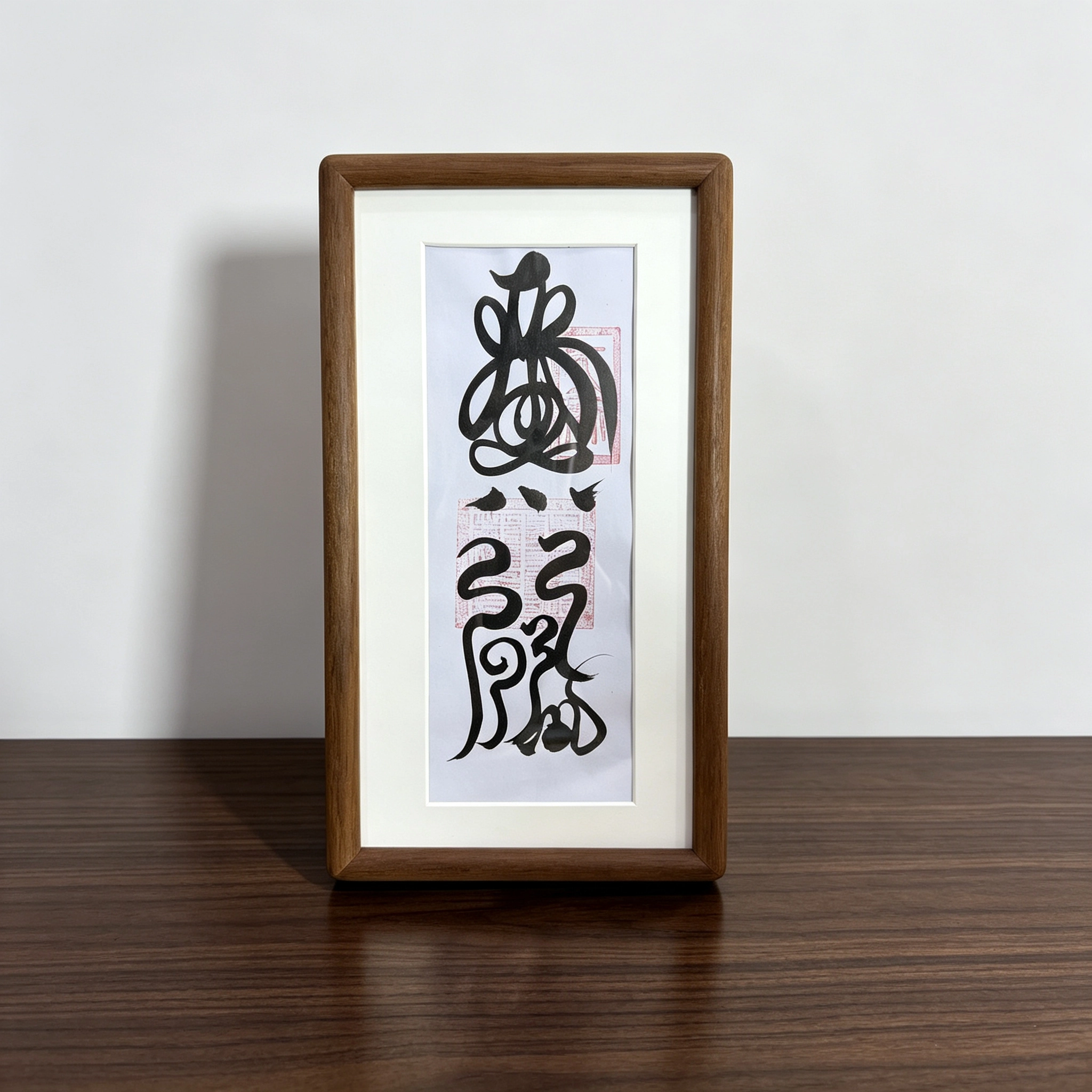
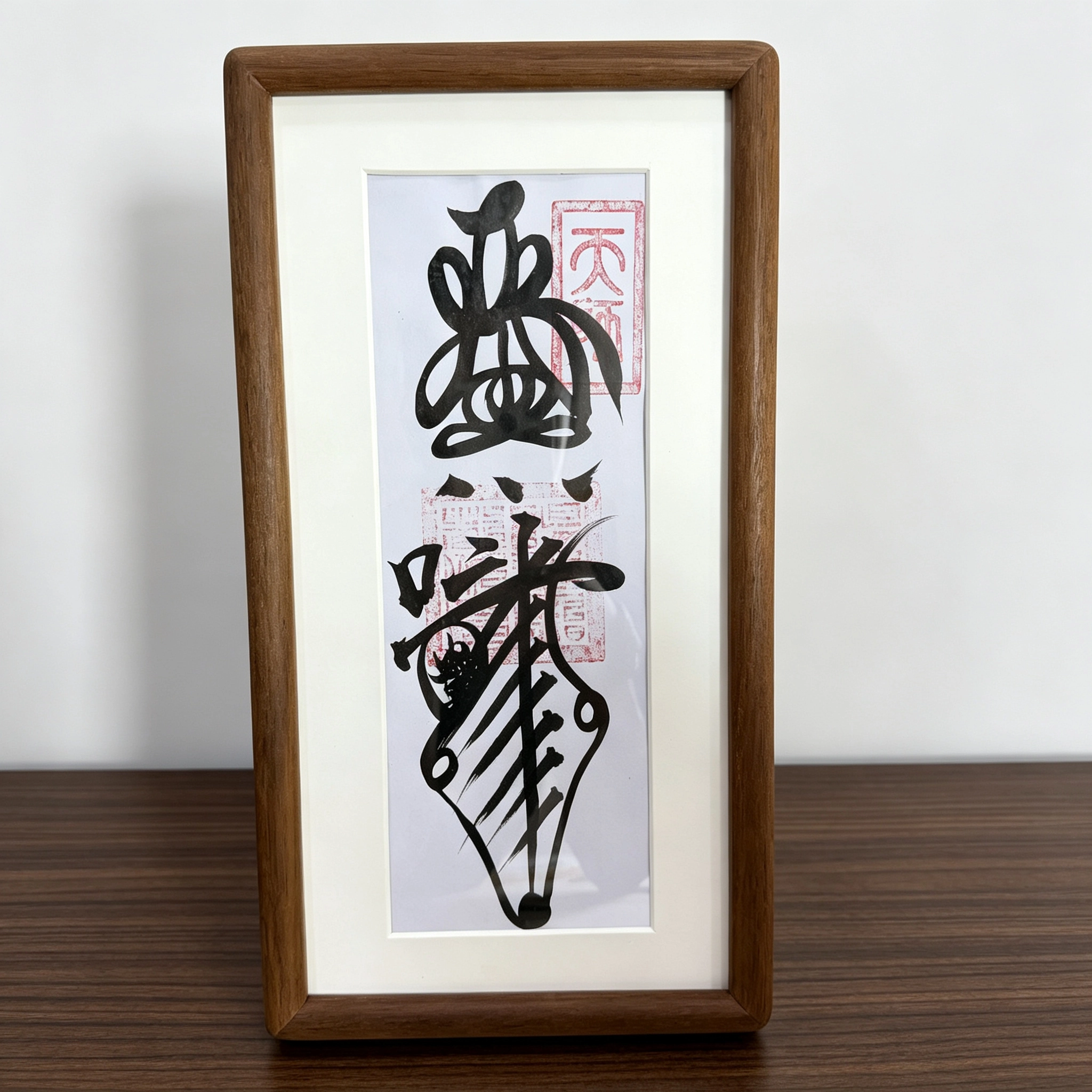
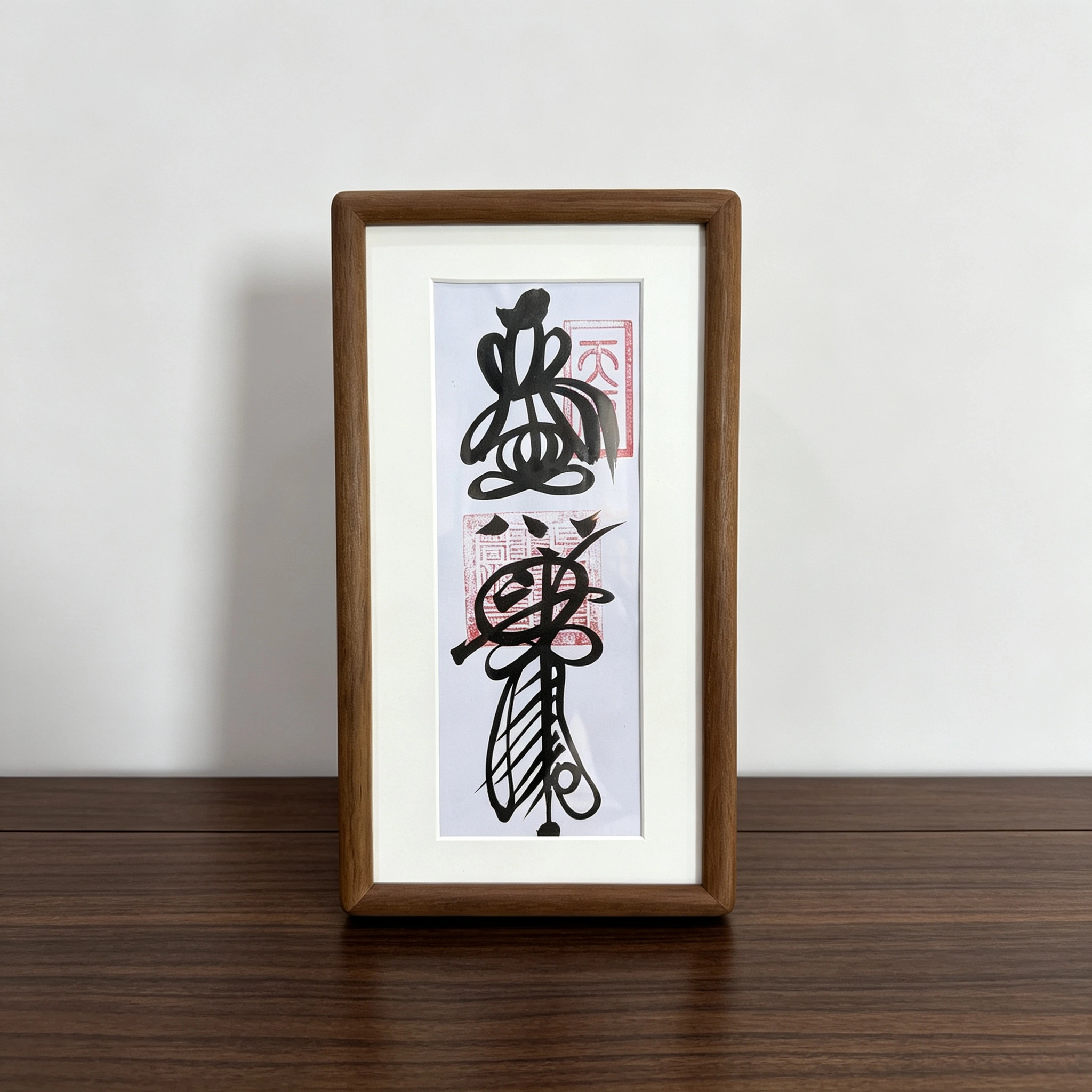
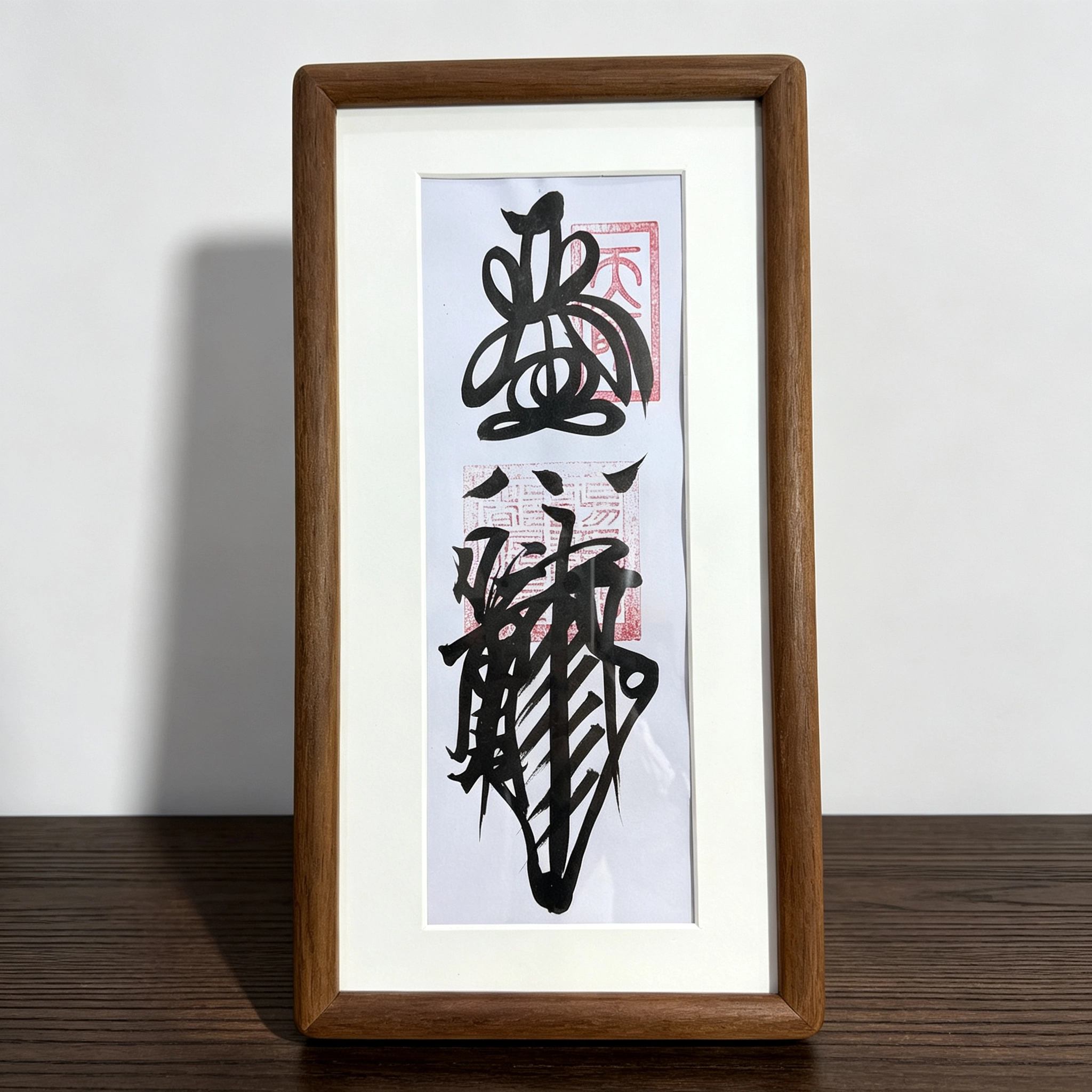
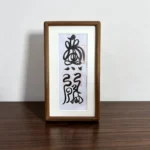
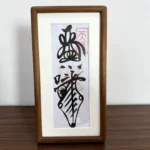
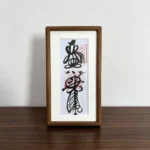
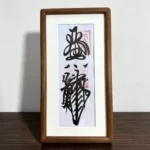
Traditional Zhang Tianshi Style · Six Symbols Available
A framed taoist talisman is not merely an ornament is not merely an ornament. It is a quiet presence for the space you live in — a mark of tradition, drawn by hand, and placed where the eye can rest.
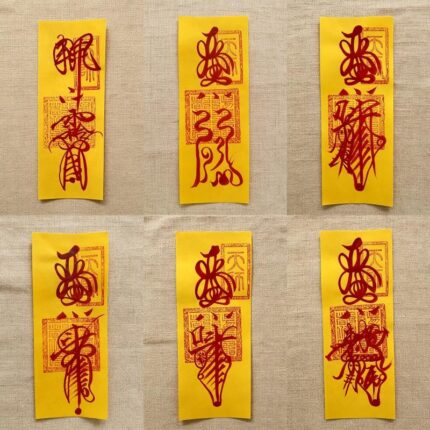
This hand-drawn framed taoist talisman is available in six designs — each drawn in the traditional Zhang Tianshi style: white paper, black ink. It is drawn by J.Li, by hand, in a single continuous movement. It is not a print. It is not a reproduction. Each piece is an original, hand-drawn work.
The style differs from the yellow paper and cinnabar version, but the essence is the same. No difference in meaning. No difference in intention.
The Framed Taoist Talisman: White Paper & Black Ink
In Taoist tradition, the Zhang Tianshi lineage is one of the most respected schools of talisman drawing. White paper and black ink are a classic form — simple, direct, and grounded. The absence of colour does not diminish the mark. It clarifies it. The black ink on white paper is like a still mind: clear, empty, and fully present.
Each framed taoist talisman is drawn once, with no second pass, no correction, no erasure. What remains is the first and only mark of its kind.
The Zhang Tianshi Tradition
The Zhang Tianshi lineage is one of the most respected schools of Taoist talisman drawing. It traces its origins to Zhang Daoling (34–156 CE), the founder and first patriarch of the Tianshidao — the “Way of the Celestial Masters” — within Taoism.
According to tradition, Zhang Daoling received a revelation from Laozi in 142 CE and was bestowed the title of Tianshi — Celestial Master. He established the first organized Taoist movement in Sichuan during the Eastern Han dynasty, and his lineage became hereditary, passing from him to his son and grandson — collectively known as the Three Zhangs.
For centuries, talismans issued by or bearing the stamp of the Zhang Tianshi were considered the most powerful in China. The title itself — Celestial Master — was often inscribed directly into the talisman, believed to imbue the mark with the accumulated exorcising power of the lineage. A Zhang Tianshi peace talisman printed in black ink on white paper is preserved in the collection of the National Museum of Taiwan History, confirming this as a recognized form. This is the tradition your talisman carries.
Today, this lineage continues as the Zhengyi school of Taoism — the most widely practiced form of Taoist ritual and talisman drawing in China. Taoist Talismans: History, Meaning, and Sacred Practice →
Six Symbols Available
Choose the talisman that speaks to you from the dropdown menu above:
A Quiet Relief
For those who wish to soften what is heavy, and to clear what is stuck.
This talisman is associated with Yin Yuan Shuai — Marshal Yin, a guardian figure in the Taoist tradition known for dispelling misfortune and clearing obstacles from the path.
Jie E means to relieve distress — not to remove every difficulty from life, but to soften what is heavy, to clear what is stuck, and to open a quiet space where ease may enter.
This is not a promise. It is a posture — one of turning toward the tradition, and asking for its presence on the road ahead.
A Quiet Presence
For those who seek a steady calm, and a quiet sense of safety in their days.
This talisman is associated with Wang Shan — Marshal Wang, a revered guardian figure in the Taoist tradition, known for his unwavering presence and steadfast protection.
In the tradition, it is known as a talisman for Ping An — meaning peace and safety, a state of quiet safety and inner peace. Not to remove every uncertainty from life, but to offer a sense of grounded calm as you walk through it.
This is not a promise. It is a companionship — one of turning toward the tradition, and asking for its steady presence at your side.
A Quiet Abundance
For those who walk the path of honest work, and keep the door open for what may come.
This talisman is for those who hold a quiet desire — for their work to flourish, for their effort to meet its season, and for abundance to find its way through many channels: through labor, through opportunity, and through the quiet returns of what has been set in motion, seen and unseen.
This talisman is associated with Zhao Gongming — known in the Taoist tradition as Marshal Zhao, a revered guardian figure who has long been honored as a protector of prosperity and rightful livelihood.
It is for those who understand that certain things carry meaning not because they are explained, but because they are felt.
It is for those who believe — or who wish to believe — that tradition, intention, and attention can be woven into a single mark, and that this mark can walk with them through the seasons of their work and their days.
A Quiet Guard
For those who wish to walk their own path, undisturbed by the ill intent of others.
This talisman is for those who wish to move through the world without the weight of others’ ill intent.
It is for those who seek a quiet boundary — a sense of steadiness in the face of gossip, jealousy, or unseen negativity.
It is for those who believe — or who wish to believe — that tradition, intention, and attention can be woven into a single mark, and that this mark can accompany them as they walk their own path, undisturbed.
A Quiet Clarity
For those who stand at a crossroads, and wish to see the next step more clearly.
This talisman is for those who seek not quick success, but a steady unfolding of their work and purpose.
It is for those who stand at a crossroads — in their career, their studies, or their life’s work — and wish for clarity.
It is for those who believe — or who wish to believe — that tradition, intention, and attention can be woven into a single mark, and that this mark can accompany them as they find their way forward.
A Quiet Harmony
For those who tend the bonds that matter, and wish to meet another with an open heart.
This talisman is for those who hold a relationship close — a partner, a friend, a family member, a kindred spirit — and wish to nurture its harmony.
It is for those who seek not to control another’s heart, but to soften their own, to listen more deeply, and to meet the other with patience and care.
It is for those who believe — or who wish to believe — that tradition, intention, and attention can be woven into a single mark, and that this mark can accompany them as they tend to the bonds that matter most.
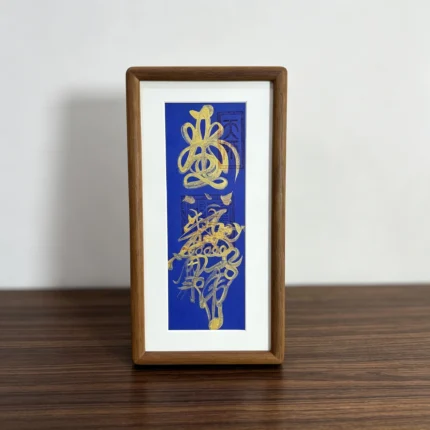
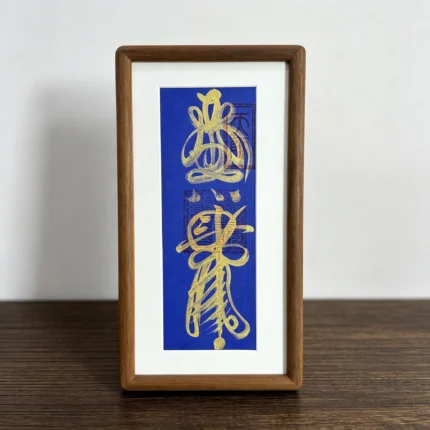
Each blue paper gold ink talisman carries the same mark as the paper version. The difference is in how you choose to live with it.
Each framed taoist talisman carries the same mark as the paper version. The difference is in how you choose to live with it.
The Hand-drawing Process
Each talisman is drawn by J.Li, by hand, with a brush and cinnabar ink.
Before the brush touches paper, there is a pause. The mind settles. The space is prepared. The form is held clearly in mind — not as an image to copy, but as a structure to embody.
In the Taoist tradition, the drawing of a talisman is understood as a practice of focused intention. It is said that the one who draws gathers inner qi — the body’s subtle energy — and directs it through the brush, combining breath, focused awareness, and the discipline of the Taoist inner arts. The hand becomes a vessel for that intention, not the source of it.
This is not a performance. It is a quiet, internal process — one that draws upon the same principles found in Taoist meditation and energy cultivation. The talisman is not “made” in the ordinary sense. It is drawn, once, in a single continuous movement, with no second pass, no correction, no erasure.
The brushwork follows traditional forms, including the use of esoteric characters and incantations passed down through the lineage — not as decoration, but as integral parts of the mark’s structure and meaning.
What remains is the first and only mark of its kind. No two are identical. Each carries its own breath, its own slight variation, its own quiet signature of the moment it was drawn.
The Complete System of Taoist Talismans →
A Note on Renewal
In the Taoist tradition, a talisman is kept for one year, then replaced with a newly drawn one. This is not because the old mark loses its meaning — it is because the tradition understands time as a cycle. A new year. A new mark. A fresh intention, drawn to accompany the days ahead.
When the year turns, a new talisman may be drawn to take its place — for those who wish to continue the practice.
The Wooden Frame
This framed hand-drawn taoist talisman comes in a simple wooden frame, ready to be placed on a desk, shelf, or table. It is designed for quiet display — not for decoration, but for presence. You may place it in your bedroom, study, living room, or office. Let it be a quiet companion in the space where you rest, work, or simply be.
During sitting meditation, you may gaze upon it — a quiet focal point for contemplation, inner reflection, and the gradual settling into stillness. In time, the mark becomes a mirror, and the space between you and it softens into a quiet resonance.
Paper vs Framed
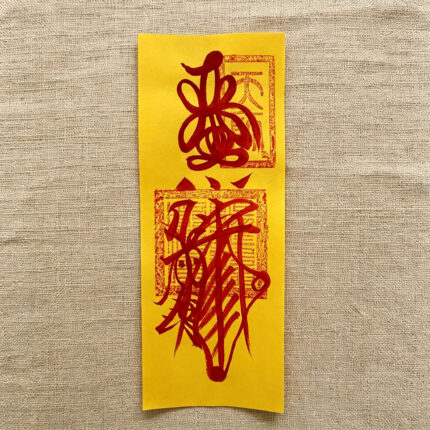
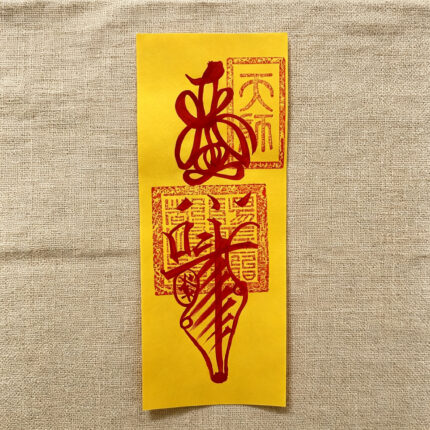
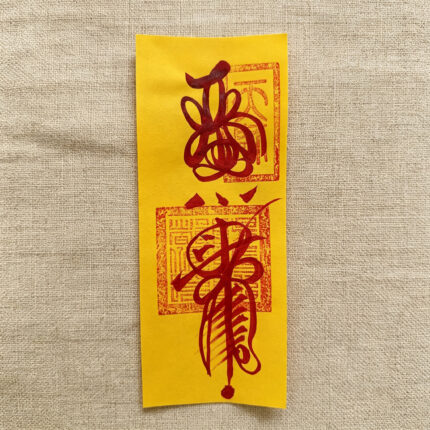
The paper version is made for carrying — folded and kept in a pouch, close to the body. The framed version is made for display — placed on a surface, where it can be seen and appreciated daily. Both carry the same mark, the same intention. The difference is in how you choose to live with it.
Explore Yellow Paper, Red ink, Inkstick Carried With Oneself Style →
Details
| Style | Traditional Zhang Tianshi style — white paper, black ink |
| Type | Original hand-drawn talisman, not printed |
| Material | Handmade paper, black ink |
| Frame | Wooden frame with stand |
| Frame size | Approx. 15 × 30 cm |
| Talisman size | Approx. 10 × 26 cm |
| Craft | Hand-drawn by J.Li, single pass |
| Uniqueness | Each piece is unique; no two are identical |
| Custom sizing | Available upon request — please email us |
| Packaging | Wooden frame, ready for display |
A Note Before You Keep It
This is a hand-drawn cultural and spiritual object.
It is not a medical device. It is not a substitute for professional advice — medical, legal, financial, or otherwise. No specific outcome is guaranteed or promised.
What is offered here is the framed taoist talisman itself — drawn by hand, in the traditional form, with sincere intention. What you make of its presence is yours to decide.
Not an answer. Not a guarantee.
A mark, drawn in stillness.
For those who know what it means —
and for those who are still learning to feel it.
FAQ
Is this framed taoist talisman a printed copy?
This is an original hand-drawn talisman by J.Li. It is not a print, not a reproduction. Each piece is drawn once, in a single pass, with black ink on white paper.
What is the difference between white paper black ink and yellow paper cinnabar?
They are different traditional styles. White paper and black ink follow the Zhang Tianshi form; yellow paper and cinnabar follow another lineage. The essence is the same. The intention is the same. Only the outer form differs.
How do I choose which talisman I receive?
Simply select your chosen talisman from the dropdown menu when placing your order. The six options are listed above.
How do I display it?
The wooden frame is designed to stand on a desk, shelf, or table. You may place it in your bedroom, study, living room, or office.
Can I request a custom size or frame?
Yes. Custom sizes are available upon request. Please contact us by email to discuss your needs — we will be happy to provide a quote.
Does it guarantee results?
No. We make no claims of specific outcomes. What we offer is the framed hand-drawn taoist talisman itself — drawn in the traditional form, with sincere intention. Its meaning and significance are personal and cultural, not contractual.
Is this suitable as a gift?
Yes. Many choose to give a framed hand-drawn taoist talisman to someone they care about — as a quiet gesture of support, rather than a promise of results. If you would like a note included, please mention it in your order.
Reviews
There are no reviews yet.